
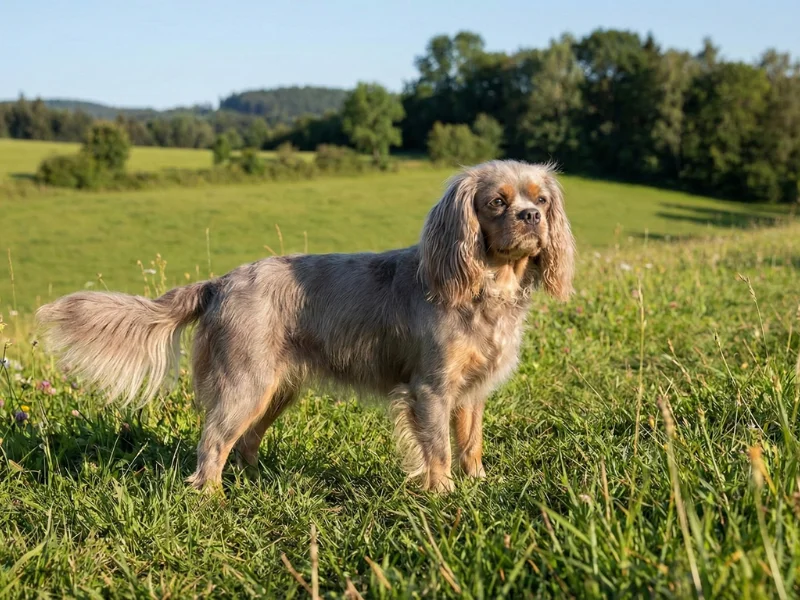
Cavalier King Charles Spaniel
Other names: Cavalier King Charles, Cavalier, C.K.C., Épagneul Cavalier King Charles
With its endearing large dark eyes and miniature spaniel appearance, the Cavalier King Charles Spaniel embodies pure elegance. This small companion dog of English origin displays a harmonious and graceful silhouette, weighing between 5.5 and 8 kg for a height of 32 to 36 cm at the withers. Its well-proporti... Read more
Are you a breeder or owner of a Cavalier King Charles Spaniel?
Create your free account and request your dog's pedigree in just a few clicks. Use our tools to manage your kennel and select your breeding stock in the best conditions.
Are you a breeder or owner of a Cavalier King Charles Spaniel?
Create your free account, manage your kennel and pedigree requests with our tools.
Create my accountHistory & Origin
T he history of the Cavalier King Charles Spaniel traces its roots to the English royal courts of the 16th century. These small toy spaniels were already living in palaces, warming the laps of high society ladies and appearing in paintings by the great artists of the era. Mary Stuart, Queen of Scots, and later James I were particularly fond of these elegant companions.
King Charles II of England profoundly shaped the breed's history between 1630 and 1685. His passion for these small dogs became legendary: it is said he preferred playing with them to managing affairs of State! These spaniels accompanied him everywhere, even to Parliament where they enjoyed exceptional entry privileges. The breed naturally took the name King Charles Spaniel in tribute to this devoted monarch.
In the 19th century, the arrival of Pugs and Pekingese from Asia altered canine beauty standards. Breeders then crossed the King Charles with these flat-faced breeds, creating dogs with shorter muzzles and rounder skulls. The original type with its elongated muzzle gradually disappeared.
In 1924, American Roswell Eldridge issued a challenge: to rediscover the spaniels of Charles II's time. He offered 25 pounds to anyone who could recreate the old type with a long muzzle and flat skull.
This quest brought forth a few specimens matching the old paintings. To distinguish them from the modern King Charles, these old-type dogs received the designation Cavalier King Charles in 1928. The first breed standard was drafted that same year.
Official recognition came in 1945 from The Kennel Club (UK), followed by the FCI in 1955. The breed arrived in France in 1975 and quickly won over French hearts.
Register your Cavalier King Charles with our club! A modern alternative to traditional clubs, offering breeders greater flexibility and innovative management tools.
Description
W ith its endearing large dark eyes and miniature spaniel appearance, the Cavalier King Charles Spaniel embodies pure elegance. This small companion dog of English origin displays a harmonious and graceful silhouette, weighing between 5.5 and 8 kg for a height of 32 to 36 cm at the withers. Its well-proportioned body conveys an impression of lightness and natural refinement.
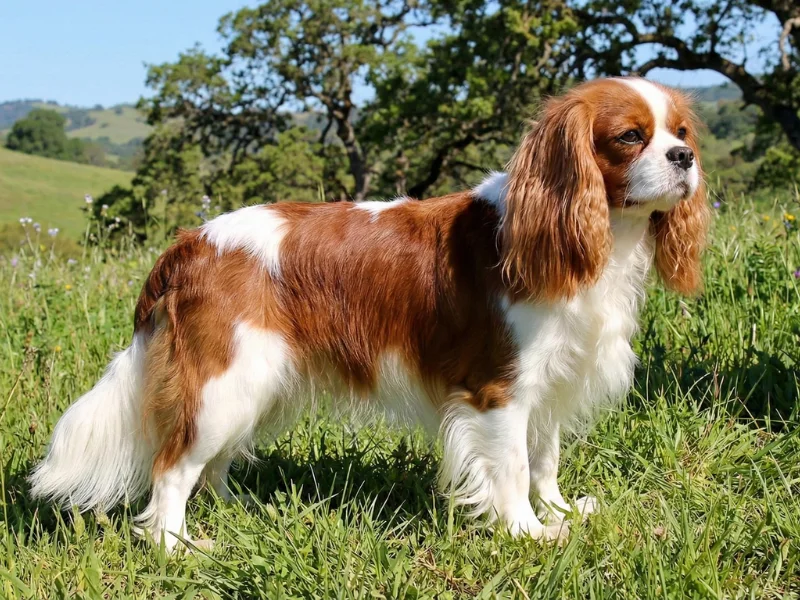
Its coat constitutes one of its most remarkable visual signatures: long, silky and perfectly straight, adorned with abundant feathering on the ears, chest, legs and tail. A slight wave may appear but never forming curls.
Four magnificent colors dress this breed: Blenheim (white and chestnut), tricolor (black, white and tan), black and tan, and ruby (solid rich red). Its long pendant ears adorned with feathering frame a head with an almost flat skull, a well-defined stop and a tapered muzzle.
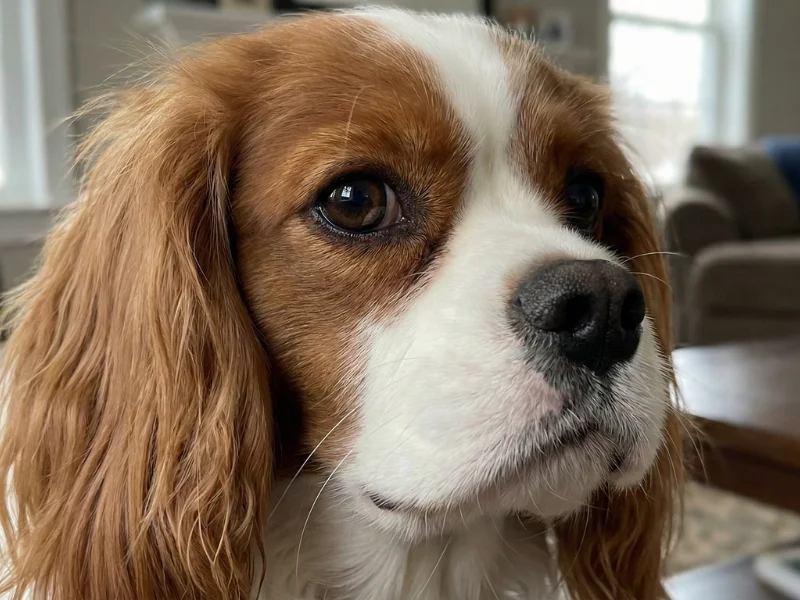
The Cavalier's expression remains its absolute charm: round, expressive eyes of deep brown that seem to tell a thousand stories. Its tail carried happily without rising above the level of the back completes this aristocratic silhouette.
In terms of temperament, this little spaniel combines gentleness and liveliness in perfect balance. Affectionate to the core, it adapts remarkably to its owners' lifestyle. Calm with the elderly, playful with children, this emotional chameleon possesses the rare ability to understand and embrace its family's needs.
Personality
T he Cavalier King Charles Spaniel radiates gentleness and affection toward his entire family. This small spaniel possesses a remarkably balanced temperament, knowing how to be playful and energetic with children, then calm and composed with elderly individuals. His adaptability stands as one of his finest qualities.
Sociable to the core, he greets strangers with warmth and forms harmonious bonds with other animals. His non-aggressive nature provides reassurance to families.
This intelligent companion learns quickly and displays a genuine desire to please his owners. However, his sensitivity makes him vulnerable to prolonged solitude.
He distinctly prefers remaining close to his humans rather than spending his days alone. His cheerful and playful character brings a touch of daily happiness to his household.
Photo Gallery


Breed Characteristics
General Information
- Category: Approval
- Origin: United Kingdom
- FCI Recognition: Yes (Group 9)
- Est. monthly upkeep: 50-70
- Daily exercise: 45 minutes
Key Facts
- Height: 32.00 to 36.00 cm
- Weight: 5.50 to 8.00 kg
- Life expectancy: 9 to 14 years
- Average price: 1000.00 to 1800.00 €
-
Grooming frequency:6/10
Training Tips
Training begins at adoption at 8 weeks of age. This intelligent little spaniel responds admirably to positive reinforcement and food rewards. His natural desire to please facilitates learning. Short, engaging sessions maintain his attention. Early socialization with various people, animals, and environments develops a confident adult. Gentleness and patience are the keys to success with this sensitive companion.
Health & Common Conditions
General Health
The Cavalier King Charles Spaniel displays a robust appearance and can live between 9 and 14 years. However, this breed presents genetic predispositions that merit particular attention. Its slightly brachycephalic morphology requires vigilance during hot weather, as the breed struggles to regulate its body temperature.
Its sensitivity to cold and humidity necessitates precautions during winter months. The natural food drive of this small spaniel predisposes it to weight gain, making a controlled and balanced diet essential.
Regular veterinary visits allow for early detection of cardiac conditions common in the breed. Responsible breeders perform health screening tests on their breeding stock. Attentive medical monitoring and annual cardiac evaluations contribute greatly to preserving quality of life.
Common Conditions
Mitral valve disease represents the primary health concern in the Cavalier, affecting a significant proportion of the population. This progressive cardiac condition presents as a heart murmur detectable upon auscultation, then progresses to heart failure. Medical treatment can slow its progression.
Syringomyelia, a painful neurological condition, also affects this breed. Patellar luxation causes lameness and reluctance to climb stairs. Eye problems include cataracts and corneal dystrophy.
Incomplete ossification of the humeral condyle results in chronic lameness. Ear infections and allergic dermatitis require regular monitoring of the ears and skin. Fortunately, early screening and veterinary advances offer effective solutions for managing these conditions.
Care & Living Environment
Daily Care
The Cavalier's long, silky coat requires regular brushing two to three times per week, ideally daily to prevent mat formation in the feathering.
A soft pin brush and fine-toothed comb facilitate this grooming routine. Two seasonal sheds in spring and fall result in increased hair loss.The breed does not require professional grooming.
The pendant ears require weekly cleaning with an appropriate solution to prevent ear infections.
The more delicate eyes benefit from gentle wiping with saline solution. Nail trimming should be performed monthly if natural wear is insufficient. Dental brushing several times per week maintains proper oral health.
During cold seasons, a light coat protects this cold-sensitive breed during winter outings.
Recommended Living Environment
The Cavalier King Charles Spaniel thrives in an urban apartment setting thanks to its compact size and adaptable temperament. A house with a yard is also suitable, though this breed strongly prefers indoor living close to its family.
Its sensitivity to cold and damp conditions requires a comfortable, climate-controlled environment. This breed does not tolerate extended periods of solitude and requires daily human companionship.
Recommended Activities
Chew toys keep him occupied during quiet moments. Recreational agility channels his boundless energy. Avoid strenuous exercise in hot weather due to potential respiratory difficulties.
Frequently Asked Questions
Yes, mitral valve disease frequently affects this breed. This degenerative heart condition develops progressively with age. A heart murmur detectable during veterinary auscultation is often the first observable sign. Annual cardiac evaluations allow for early detection. Appropriate medical treatment slows disease progression and considerably improves quality of life. Responsible breeders test their breeding stock to limit genetic transmission.
Absolutely! The Cavalier adapts perfectly to apartment living thanks to its small size and calm temperament. In fact, it prefers indoor living close to its family rather than a large garden without human companionship. Its moderate energy level is satisfied with daily walks of 30 to 60 minutes. This small spaniel rarely barks and naturally respects the neighbors' peace and quiet. Its primary need remains the presence of its owners rather than a vast space.
Le Cavalier King Charles does not tolerate prolonged solitude well. This companion dog develops a very strong attachment to its family and truly suffers from extended absences. Ideally, avoid leaving him alone for more than 4 to 5 consecutive hours. Repeated absences cause anxiety and undesirable behaviors. If your schedule requires it, this breed is unfortunately not suitable for you. However, families with a daily presence at home will find in him a devoted and deeply bonded companion.
The Cavalier's long, silky coat requires regular brushing two to three times per week, ideally daily. Use a soft pin brush and a fine-toothed comb to detangle the abundant feathering on the ears, chest, and legs without pulling.
The two annual shedding seasons in spring and fall require more frequent brushing. No professional grooming is necessary, as the breed standard actually prohibits trimming. An occasional bath with a mild shampoo preserves the natural luster of the silky coat.
The Cavalier King Charles Spaniel displays four official coat colors recognized by the breed standard. The Blenheim features a pearly white ground with chestnut markings, sometimes with a spot on top of the skull. The tricolor blends black, white, and tan harmoniously distributed. The black and tan coat displays a deep black with tan markings above the eyes, on the cheeks, and on the legs. The ruby, more rare, exhibits an intense solid red without any white markings. Each color possesses its own unique and distinctive charm.
Expert Rating
Overall rating for the Cavalier King Charles Spaniel
This overall rating is calculated from 7 key criteria: activity level, trainability, guarding ability, child and animal friendliness, grooming frequency and barking level.
Activity level
Trainability
Sociability
Guarding ability
Breeds from the Same Group
Discover other dog breeds from the same group