

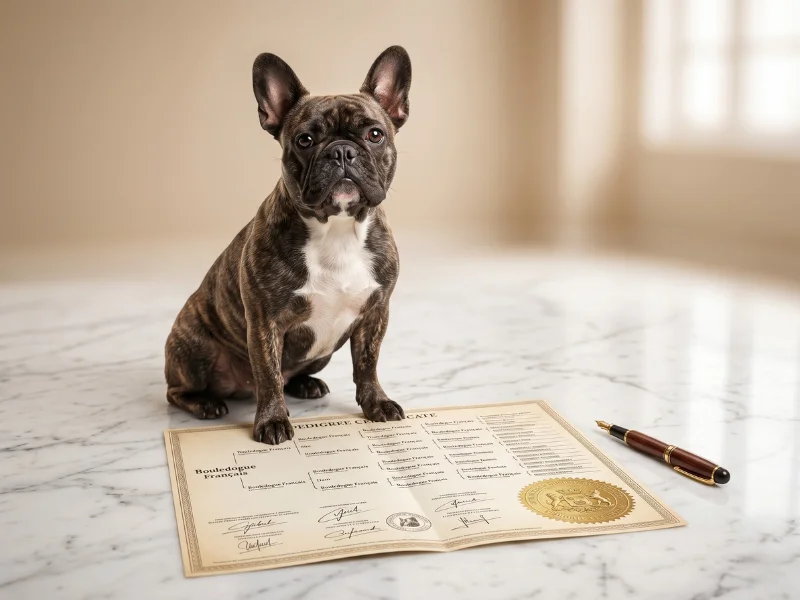
No Pedigree? Here's What Your Dog Is Really Losing
Wondering if your dog actually needs a pedigree? That's exactly the right question to ask. We're going to answer it clearly and honestly.
A pedigree is more than just paperwork. It's proof, protection, and a real advantage for your dog, and for you as a responsible owner.
What Is a Dog Pedigree and Why Should You Care?
Everyone's heard of a dog pedigree. But most owners have no real idea what it actually contains, what it proves, or why it matters so much for their dog. Before diving into the benefits, let's start with the basics and get everyone clearly on the same page.
• More Than a Certificate: What It Actually Proves
A dog pedigree certificate is an official document of origin, issued by a recognized and accredited organization. It proves that your dog descends from a purebred, identified, and registered lineage. The document traces ancestry across multiple generations, usually three or four levels deep.
It lists the names of parents, grandparents, and great-grandparents, along with their individual registration numbers. It also records the breed, coat color, date of birth, and the identification number from a microchip or tattoo. In short, this is your dog's genetic ID card. Without it, there is simply no way to verify or trace the breed's true origin.
This document carries real legal and official weight. A responsible breeder cannot produce it on their own. It follows a strictly regulated process: verifying the parent dogs, confirming the mating, and officially declaring the litter to an accredited registry. Across Europe, each FCI member country runs its own national studbook.
The Kennel Club handles registrations in the UK, the VDH in Germany, the RSCB in Belgium, and the RSCE in Spain. Each body applies its own procedures, but all share the same foundation: a standardized, verifiable record that holds up internationally. This breed registration paperwork quickly becomes a mark of seriousness and transparency, both for the breeder and the future owner who wants to know exactly what they are getting.
• Who Issues Pedigrees and How the Process Works
Multiple organizations worldwide are authorized to issue recognized breed certificates. The best-known at the international level remains the Fédération Cynologique Internationale (FCI).
Founded in 1911, it now brings together 94 member countries and contract partners, with each one issuing its own certificates according to shared FCI standards.
In the UK, the Kennel Club operates entirely independently from the FCI. In the US, the American Kennel Club (AKC) fills that same role. Each organization applies its own rules, but the core mission never changes: guarantee full traceability and preserve the long-term genetic integrity of recognized purebred breeds.
Not every registry operates under the FCI umbrella. Independent organizations like the UKC (United Kennel Club) and the ABKC (American Bully Kennel Club) run their own certification systems, fully recognized within their respective communities.
The French Breed Kennel Club (FBKC) is a dedicated registry for dogs breeders and owners worldwide. It offers a fully online platform for genealogy tracking, litter registration, and pedigree management.
Every registry has its own specifics. But regardless of which one you use, the quality of the process and the accuracy of the recorded data are what give the final document its real legitimacy and value.

What a Pedigree Tells You About Your Dog
A breed registration certificate is more than a list of names. It carries real, actionable information about your dog's genetics, health background, and how closely it matches the breed standard. Here is what that document actually reveals, and why every line in it matters.
• Tracing the Genetic History Across Generations
A pedigree document maps your dog's lineage across three to four generations of ancestors. Every registered ancestor carries concrete genetic information. You can spot recurring champion bloodlines, identify repeated pairings, or flag a coefficient of inbreeding that has crept too high.
A serious breeder studies this data before every mating. They do not pick a stud dog at random. They work to reinforce breed strengths while actively reducing hereditary risks. This is a deliberate, documented, long-term selection process, and the registration certificate is the paper trail behind every decision.
This generational traceability also allows breeders to calculate the Coefficient of Inbreeding (COI). The lower the COI, the better the genetic diversity. A high COI increases the likelihood of passing on hereditary conditions.
Serious breeders track this figure closely, and some registries display it directly on the certificate or within their online database. It is a practical breeding tool, not a piece of technical jargon reserved for geneticists. Any responsible breeder or informed buyer can and should understand it.
• Health Screenings and Breed Standard Compliance
A solid registration certificate regularly comes alongside official health test results for the parent dogs. Depending on the breed, these screenings cover specific conditions: hip and elbow dysplasia, eye and cardiac evaluations, and DNA-based tests for inherited diseases.
In Europe, laboratories like Antagene provide breed-club-recognized genetic analyses.
In the US, Embark has become the go-to platform for comprehensive canine DNA health screening. These results attach to the dog's file and significantly strengthen the value of the document.
Breed standard compliance is the other side of the equation. A dog registered with a recognized body must meet the morphological criteria defined for its breed. Height, weight, bone structure, coat color: each point can be evaluated at a show or by an accredited judge. This is not purely about aesthetics.
It guarantees that the defining characteristics of the breed pass consistently from one generation to the next, in line with the official standard that breeders and kennel clubs worldwide work to uphold.

How a Pedigree Protects the Buyer
Buying a dog is a 10 to 15-year commitment. Before any money changes hands, buyers need real guarantees. A breed registration certificate delivers exactly that: it filters out dishonest sellers, holds breeders accountable, and makes the entire transaction significantly safer for everyone involved.
• Your Best Defense Against Scams and Backyard Breeders
Without official paperwork, anyone can sell a puppy and claim it is purebred. Backyard breeders and puppy mills thrive on buyers who ask no questions. A breed registration certificate changes that immediately.
It proves the animal exists in a recognized registry, that the parents went through proper health checks, and that the breeder followed a regulated process from start to finish.
It is the most concrete protection available to any buyer. A puppy sold without this document offers no real guarantee about its true origin, its health status, or its genetic stability as an adult.
Poland took a firm legislative stand in 2012 by banning the sale of dogs and cats without a recognized origin certificate. The law directly targeted clandestine intensive breeding operations. India has followed a similar path, with the Kennel Club of India (KCI) playing an increasingly central role in the registration process for purebred dog sales.
These legal developments reflect a clear global trend: governments now formally recognize that a registration certificate protects both the animal and the buyer. What was once a voluntary step is quickly becoming a legal requirement in more and more countries around the world.
• Building Trust Between Breeder and New Owner
A breeder who hands over a complete registration document has nothing to hide. The parent dogs' names, health test results, and registration numbers are all independently verifiable. The buyer can contact the registry, check the online database, and confirm every detail before finalizing the purchase.
This level of documentary transparency builds real trust between both parties. It holds the breeder accountable well beyond the point of sale. And it puts the buyer in a position of confidence when making a decision that will shape the next ten to fifteen years of their life.
Handing over the registration certificate usually comes with a detailed sale contract. This document outlines the terms of the transaction, the guarantees the breeder commits to, and sometimes specific clauses around future breeding rights.
These legal elements give the buyer real protection if something goes wrong down the line. In a dispute, the breed certificate becomes a key piece of supporting evidence.
It strengthens the buyer's position and simplifies any claim with a kennel club or legal authority. Buying without these documents is buying blind, and no price reduction justifies that risk.

The Real-World Impact on Your Dog's Value and Career
A breed registration certificate is not just a formality. It opens real doors: official competitions, internationally recognized titles, and a significantly higher market value. Here is what a properly registered dog can achieve that an unregistered one simply never will.
• Shows, Titles, and Competitions: Pedigree Is Non-Negotiable
Want to enter a dog show or a working competition? Without a recognized registration document, the door is closed. Every major kennel organization in the world, the FCI, the AKC, and the Kennel Club included, requires official registration as a condition of entry. In the show ring, judges evaluate morphology, movement, and adherence to the breed standard.
Points accumulated at competitions lead to official certificates such as the CAC and CACIB, and open the path to National or International Champion titles. Every title earned goes on record and increases the genetic value of the bloodline for future litters.
The French Breed Kennel Club (FBKC) runs its own structured show and competition calendar, with a clear points and classes system fully recognized across its membership. Every registered dog gains access to official events and the ability to accumulate points toward titles specific to the breed.
Explore the full details on the FBKC shows and exhibitions page and the points and classes system page directly on the site. Without a valid registration certificate, no participation is possible. The registration document is the only key that unlocks a French Bulldog's entire competitive career.
• Why Registered Dogs Sell Faster and for More
The resale market tells a clear story. A dog registered with a recognized body consistently sells for a significantly higher price than one without official paperwork. The gap can reach several hundred to a few thousand dollars or euros, depending on the breed and the titles held by the parent dogs.
A registration certificate backed by a champion bloodline pushes that value even higher. The buyer knows exactly what they are getting. The breeder receives fair recognition for their selection work. And the seller has a solid, verifiable argument to support their asking price.
Beyond resale value, registration also directly impacts a dog's breeding potential. A registered stud or dam attracts stronger demand from serious breeders looking to maintain quality in their lines. Their litters automatically carry a traceability that makes them far more attractive on the market.
It becomes a virtuous cycle: proper registration leads to better selection, better selection builds a stronger reputation, and a stronger reputation commands better prices.
The official breed certificate does not just protect the dog. It validates every hour of work the breeder has invested over years of dedicated, responsible breeding.

How to Register Your Dog's Pedigree: A Simple Guide
The process is simpler than most people think. A few key details, the right documents, and the right registry: your dog can have a recognized registration certificate in just a few steps. Here is how to get it right the first time, without delays or setbacks.
• Step-by-Step: Getting It Done Right the First Time
The first step is picking the right registry for your breed and situation. Requirements vary from one organization to the next. If your dog already has an existing birth certificate or registration document, the transfer process to a new registry follows a standard declaration procedure with origin verification.
If your dog has no existing paperwork, some registries offer an initial registration option. The FBKC, for example, accepts initial registration requests for most breeds, provided you supply the names and colors of both parent dogs. It is a legitimate, traceable starting point for building a proper, recognized bloodline from the ground up.
Once you have chosen your registry, the process moves fast. Create an account on the platform, fill in your dog's details (breed, date of birth, microchip number, coat color), attach the required documents, and submit your application. On the FBKC, everything happens online with no unnecessary paperwork and no delays from manual processing.
Create your account directly on the FBKC registration page and get started right away.
You can check the full status of your application at any time from your personal member dashboard.
• Common Mistakes That Delay or Void Your Application
The most common mistake is submitting an incomplete application. A missing document or a single incorrect detail is enough to put the whole process on hold. Always confirm that your dog's microchip number appears in a nationally recognized identification database before submitting anything.
One important rule to know at the FBKC: owners of American Bully dogs must provide an existing pedigree certificate or registration coupon. Without that prior document, no application can go through.
This rule exists to protect the integrity of the registry and uphold the real value of every certificate issued to its members.
For all other breeds, the FBKC offers a practical path: the initial registration option. Even without any prior documentation, registration is possible as long as you provide the names and colors of both parent dogs.
This gives any owner or breeder the ability to start a clear, serious, and recognized genealogy from a solid foundation.
It is one of the most accessible routes into structured, responsible breeding. One key piece of advice: never enter approximate or unverified information.
The accuracy of the data you provide from day one directly shapes the quality and credibility of your dog's entire future genetic record.

Frequently asked questions
A pedigree is not mandatory to own a dog. However, it becomes a requirement for entering official shows, competitions, and recognized breeding programs.
In some countries like Poland, it is required by law for the commercial sale of purebred dogs, with similar regulations emerging worldwide.
Costs vary by registry. UK Kennel Club registrations start around £30 to £60. In the US, AKC litter registration starts at around $25 to $35.
Specialized registries like the FBKC offer competitive pricing (around $15 to $35) with a fully online process, no hidden fees, and no unnecessary delays in processing.
Yes, under certain conditions. For most breeds, the FBKC offers an initial registration option: provide both parents' names and colors to start a recognized genealogy.
American Bully owners, however, must first provide an existing pedigree document or registration coupon before any application can proceed.
The AKC and FCI are two separate organizations with their own breed standards and pedigree systems. The AKC operates in the US, while the FCI spans 94 member countries globally.
Independent registries like the FBKC also issue their own recognized certifications, fully valid within their membership communities.
A standard pedigree covers three to four generations of ancestors, including parents, grandparents, and great-grandparents. Some registries offer extended records going further back.
Each ancestor appears with a name, registration number, and sometimes show titles and health test results for full genetic transparency.



Breeds mentioned in this article